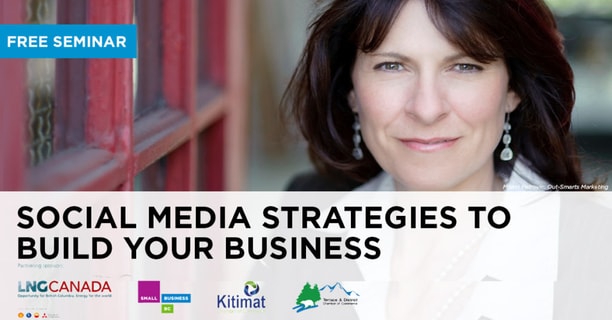
Next week, Mhairi will be heading up to Northern BC to present ‘Mastering Social Media to Grow Your Small Business” at the Terrace and District Chamber of Commerce on February 27th then on to the Kitimat Chamber the next night. The Terrace event is full but there are still a few spots in Kitimat. Click on the link to register below.
Just because you know what social media is, does not mean that you necessarily understand how to use it to grow and develop your business. This workshop focuses on understanding social media, what is it and how it’s connecting people.
Learning Objectives:
Learn how/if social media should be an important part of your marketing strategy.
Understand what opportunities are available for you to leverage social media for business growth and prospecting.
Ten years into the great social media experiment and 2017 was the year we saw Facebook hit the 2 billion user mark, the proliferation of real-time video across social platforms and the continuing email renaissance. With 2018 coming up fast upon us what better time to reflect on the past year, to dust off the crystal ball and to predict what 2018 will bring for marketers.
This post is divided into five sections to mirror the disciplines Out-Smarts focuses on websites trends, SEO – getting found when people search online, email marketing, social media and overall marketing strategy.
Website Design Trends
We know that Google is going to continue to emphasize the importance of mobile in 2018 so expect to see function taking precedence over form with a focus on usability and minimalist site navigation and content proliferating. It’s going to be interesting to see how the content is king crusaders balance their obsession with publishing content with minimalism and mobile. Expect to see more valuable content related to buyer intent rather than simply content for the sake of putting something out there.
Will 2018 be the year when small businesses finally catch up? 50% of small businesses still don’t have a website; we’re hoping this new year will be the one the laggards finally catch up. It is interesting that social media adoption for small business is much higher than website adoption. The popularity of social media is likely because of a low barrier to entry of social platforms. However, it is important to consider that you don’t own your Facebook, LinkedIn or Twitter pages (or any other social media presence you might have) the social media company owns it. What happens if they switch directions or go out of business? A website belongs to your business, not to a third party.
Watch out for more animation (logos in particular) and websites that incorporate GIFs in 2018 too – hopefully, they’re less cheesy than their Flash predecessors. Artificial Intelligence is going to be everywhere in 2018 too as enhancements make Chatbots get better and better at answering questions and simulating conversations with website visitors.
Search Engine Optimisation
Don’t let anyone tell you that keyword research is no longer important. It is and will continue to be, but there will be a shift in 2018 to focus more on semantic search, buyer intent and topics rather than specific keywords. SEOs will focus more on having their site show up at the right time when people are actually considering a purchase, rather than having the site show up to attract particular personas.
Another aspect that should be on your SEO radar in 2018 is voice search which means you need to hone your long tail keywords, i.e. keyword phrases that are hyper-specific to what you are selling.
Image search will continue to grow in 2018 so now might be the time to make sure all the images on your website have well thought out and optimized alt tags.
Email Campaigns
The email renaissance will continue in 2018. Get ready to watch videos embedded directly in email campaigns. Technological enhancements in email clients will continue to lead to more and more email apps that support embedded video. Right now less than half of all email clients can play embedded videos but thanks to Apple mail, iOS and Samsung this is changing. Up until now, most senders have opted to embed a fake play button in the email with a link to the video on a separate site or by GIF.
Including video in emails can lead to big increases in open rates – Campaign Monitor
Watch for more sophistication in list segmentation too. Segmenting campaigns so that specific audiences receive emails that contain content tailored to their unique perspective.
Social Media
2017 was the year of streaming video in social media; LinkedIn In and Twitter followed Facebook Live’s lead and began supporting live streaming video content. In 2018 watch out for growing adoption of these technologies and more creative live streams.
Over 8 billion videos or 100 million hours of videos are watched on Facebook every day (TechCrunch, 2016). – via Buffer
In 2018 we will also see the increased adoption of short-lived content, content that’s only available for a short period of time before it disappears, – like Instagram stories and Snapchat. Marketers must start developing strategies to maximize the reach and impact of ephemeral content as well as considering tactics to get this content noticed.
On platforms like Instagram and Facebook, only a tiny percentage of followers actually see the content you share on your page. To get noticed in 2018, you will need to invest in ads on these platforms. Consider video ads to spice things up a little.
Social media analytics, measuring tools and management solutions will become more sophisticated in 2018 with an emphasis on enterprise social marketing integrating all platforms.
How Marketing Strategies will Evolve in 2018
I am going to go out on a limb here and predict that 2018 will be the year that our obsession with all things digital and only digital will end. It’s also going to be the year we’re going to start calling our discipline marketing again (rather than digital). Marketing in 2018 will encompass all aspects of the marketing mix, both online and off and marketers will use the means most likely to help them attract their target audience.
Consider this, there are 65 million business pages on Facebook, 90% of businesses use social media. These are substantial numbers, but for marketers this means that it is becoming increasingly difficult, not to mention more expensive, to get noticed. If you want to attract your target audience’s attention in 2018, then widen your horizons and consider sending them a direct mail piece (depending on the audience) in a nice coloured envelope with handwritten wording. It will likely be the only physical mail the recipient gets that day (or maybe that week or month!), they’re going to open it, and if your copy is effective they will act on it!
Conclusion
2018 is going to be an interesting year; technological advancements will continue to speed up. To be effective as marketers, it’s going to be important not simply to jump on the bandwagon of the next big thing but to consider options strategically and with your target audience in mind (rather than from a product or service-centric perspective). That said, video popularity has been growing year over year and won’t stop. Cisco predicted that video would account for 80% of internet traffic by 2020. So if you do nothing else, consider how you might incorporate video into your digital approach in 2018.
Advertising on Facebook is becoming more and more sophisticated to the point that you now have many different options to help you build your audience, get followers attention and drive traffic to your website.
If your goal from advertising on Facebook is to drive website traffic and conversions, then installing and taking advantage of Facebook Pixel is a must.
What is Facebook Pixel
The Facebook Pixel is a piece of code that you install on your website. It allows you to more effectively measure the performance of your ad campaigns and it helps you determine exactly who sees your ads.
The features and benefits of Facebook Pixel include:
Ability to track customers across devices
More effective targeting
Create custom audiences for retargeting
Uncover niche segments that are similar to your current ones
Dynamic remarketing of ads – people who visit your site will see your ads on Facebook
Audience insights
Getting started with Facebook Pixel
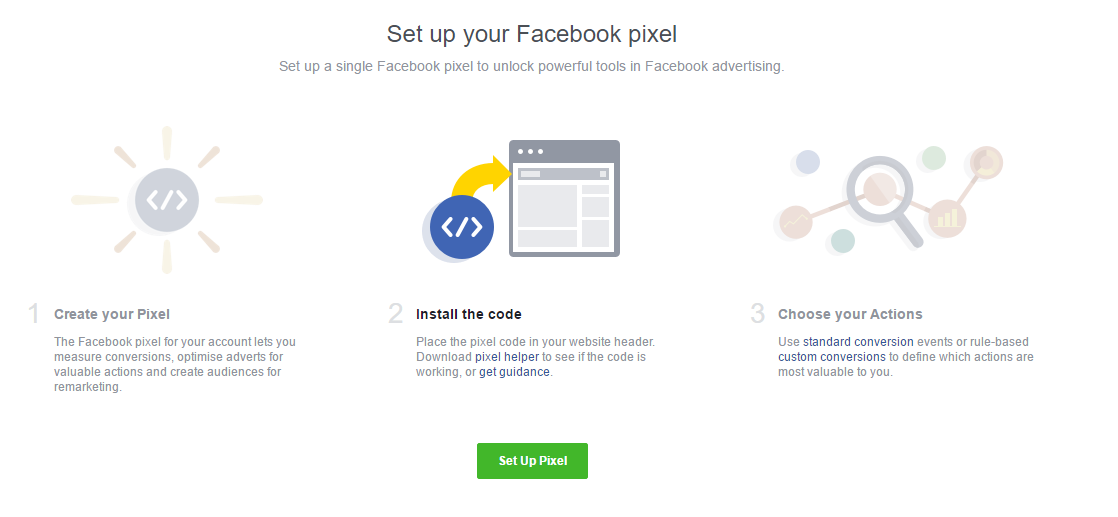
To install Facebook Pixel, go to the link below to create your Facebook Pixel.
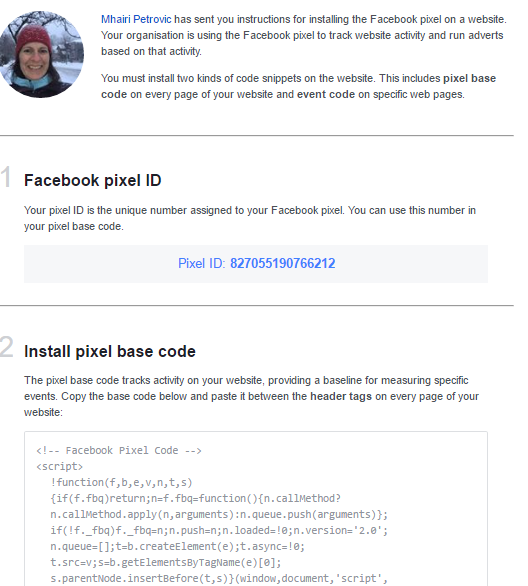
There are 2 types of code you have to install on your site to complete this process.
The first is the pixel base code that goes on all of your pages.
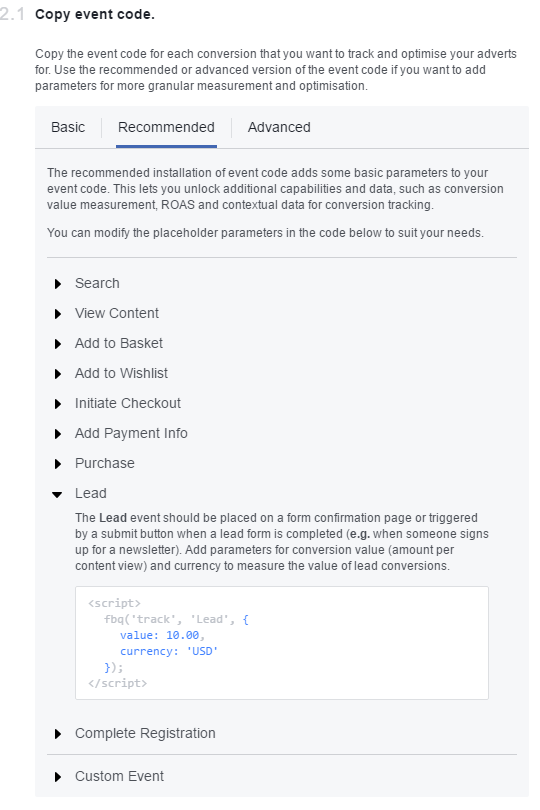
The second is the event code which you place on certain pages that you want to track specifically.
Creating Your Facebook Pixel
Facebook is going to step you through a process to set up your pixel and to get the codes for your site.
Installing Facebook Base Pixel on Your Website
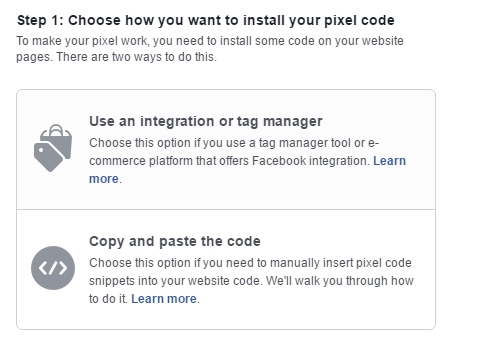
The next step is to choose which method you want to use to install the Pixel on your site:
1. Using a tag manager 2. Copy and paste the code
In order for your Pixel to work, you must copy and paste the code into your website. This cookie allows your site to send information back to Facebook and measures visits and where people go on your site.
We prefer to copy and paste the code into the website rather than using a tag manager because that way you have more control over things that can go wrong but if you are not familiar with the code of your site you might want to go with the first option. There are also several WordPress plugins that facilitate this.
Facebook generates a handy dandy Facebook Pixel ID and instructions to send to your webmaster. The code has to go on every page of your site for it to work properly. The best way to do this is to install it in your header file somewhere between the <header> and </header> and before the <body> tag.
Pixel Events Code
The Facebook Pixel events code tracks specific actions on your pages. The first thing you need to think about is your website’s call to action – what is it that you want people to do on your site? There are 3 options in the setup process.
Basic – lets you track events and optimize for conversions based on people who take action on your site.
Recommended – includes all of the above along with basic parameters providing additional data and measurement parameters.
Advanced – adds an extra layer to include product level granularity (i.e product type, style).
Here are the standard Facebook Pixel options:
View content
Search
Add to basket
Add to wishlist
Initiate checkout
Add payment info Make purchase
Lead
Complete registration
Choose the most appropriate of these depending on your goals for website traffic, conversions and what it is you want to track.
Once these pieces of code have been installed on your site you will get a Facebook notification.
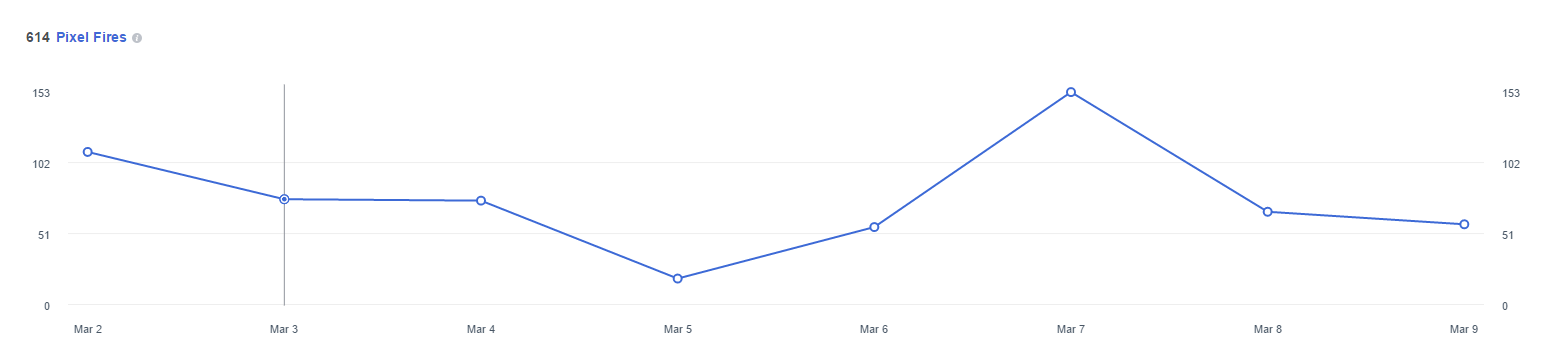
You can check to see if your Pixel is working by going to your Facebook Ads Manager. There you will notice a new Pixel tab.
Click on it to see your Pixel Fires (total amount of pixel activity in the date range).
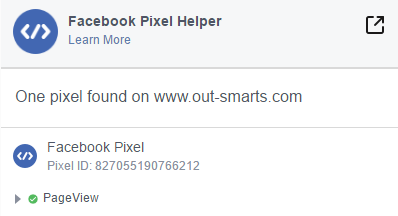
To troubleshoot or validate your Pixel set up, there’s a useful Chrome add-on called Facebook Pixel Helper.
Facebook Pixel Next Steps
Now that you’re all set up with Pixel, it’s time to create audiences and track conversions.
Create Audience
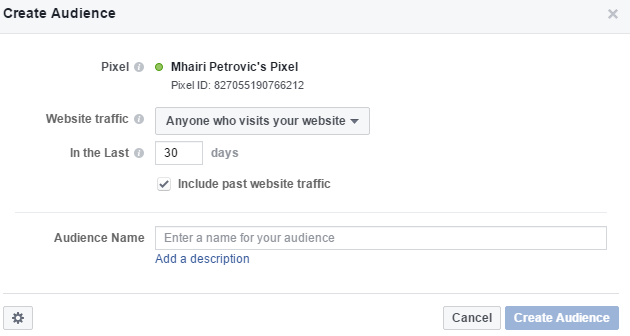
This allows you to target your Facebook ads to audiences of people who have visited your website and lets you remarket to them.
From your Facebook Ads Manager click on Pixel then on the ‘Create Audience’ button. Audience options include:
• Anyone who visits your site • People who visit specific pages • People who visit specific pages but not others • People who have visited in a certain amount of time • Or, you can create your own custom combo.
Decide which option best fits your needs, name your audience and that’s it. You are ready to create your first remarketing ad on Facebook but first, you have to wait till your custom audience is big enough.
Create Conversion
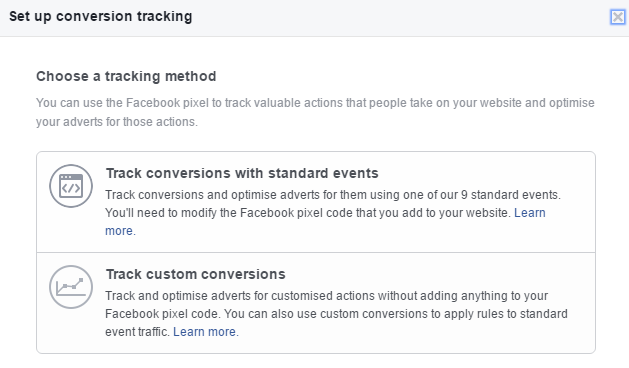
From your Facebook Ads Manager, click on Pixel then again on the ‘Create Conversion’ button.
This time you have 2 options:
Track conversions with standard events – use this if you simply want to track and optimize conversions and build your audience.
Track custom conversions – use this if you can’t use standard events on your site or if you want to split conversions on your site.
Okay, so you’ve developed a presence on Facebook for your business and want to start using Facebook Ads, but where do you start? How do you advertise on Facebook? When you start delving into Facebook’s advert guides, it can all feel a bit confusing, but don’t fret! We are here to help guide you through the process. Since our last post about how to advertise on Facebook, their Adverts are still a very strong tool, but now with more options. Follow these tips and you will be up and be advertising on Facebook in no time.
Facebook Reach / Audience
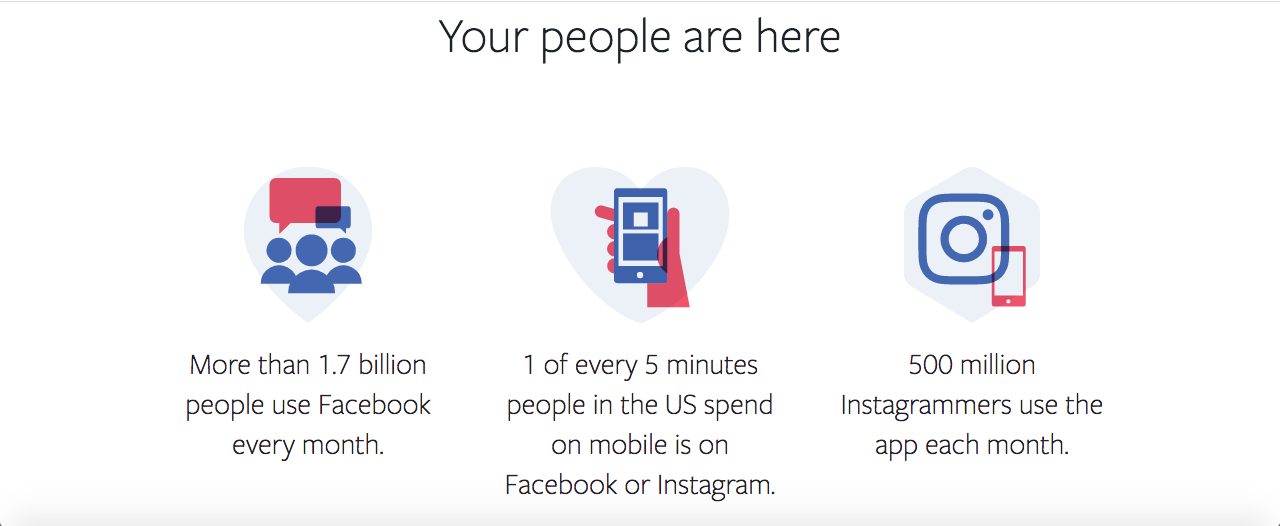
Before we begin, let’s take a look at Facebook’s stats, which are quite impressive. Back in April of 2012, Facebook bought Instagram and as a result, it has opened up your reach to a wider audience. This means you can link your business’ Instagram page to your Facebook Advert account and your ad will automatically show up on both platforms. Together Facebook and Instagram have almost 2 billion users visiting their sites each month. Even with competitors like Twitter, LinkedIn and Snapchat, Facebook is still number one when it comes to the number of users and potential consumers.
Do You Have a Facebook Business Page?
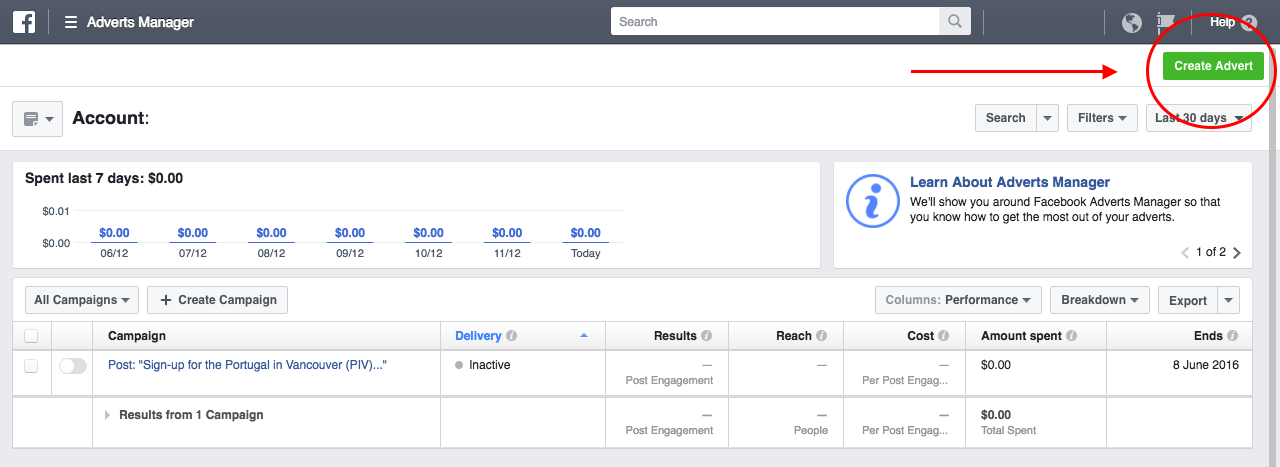
Before you start, make sure you have a Facebook Business Page as you cannot create ads via your personal Facebook page. While there are a number of ways to access Facebook ads, we recommend signing up for “Business Manager” and creating an “Adverts Manager” account to design and manage your ads. One of the benefits of doing it this way is that it allows businesses to give access to multiple people working together on an advert campaign and to easily see who is working on what. You can even assign your employees specific role-based access to adverts in order to control what they can see on your account. Once you’ve signed up for an Adverts Manager account it will walk you through each step.
Determine Your Marketing Objective
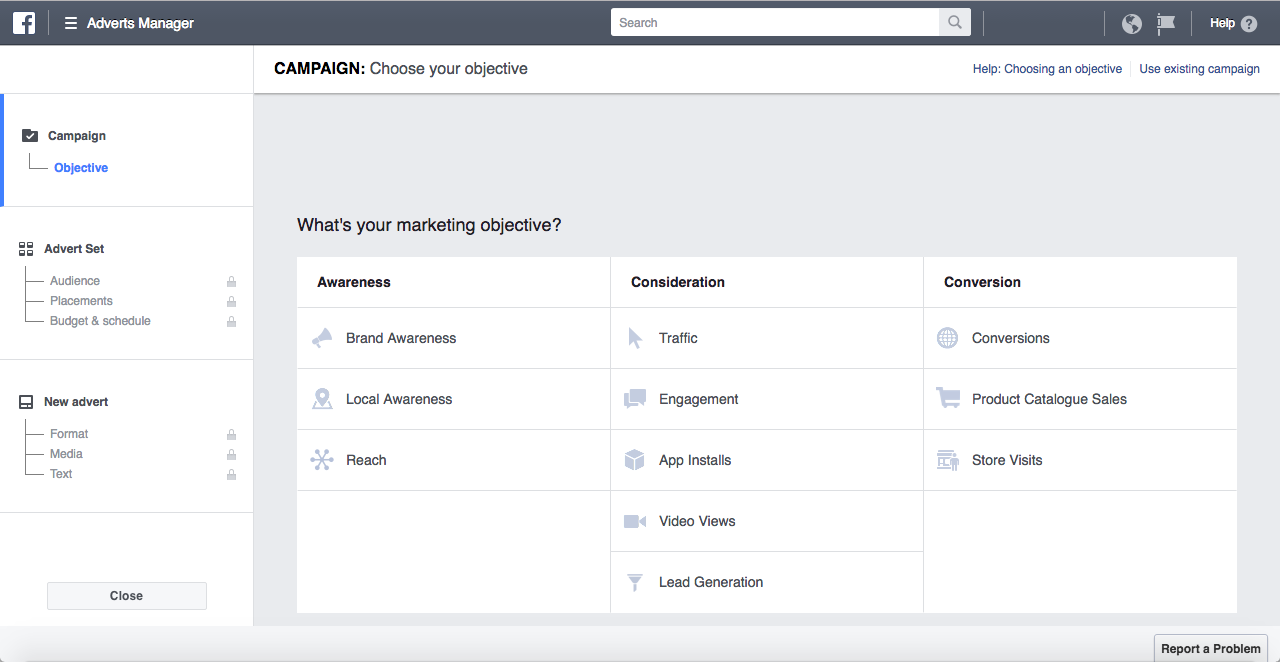
Every campaign starts with an objective so determine what yours is. Not sure? Facebook helps you determine your marketing objective by defining each type of objective they offer to help guide you to the outcome you want for your campaign. When you are setting up your ad campaign, you will see a list of all the possible objectives (see image below). You can click on each objective for its definition to help you decide which one is best for you and your business goals.
For more detailed information, read Facebook’s “Advertising Objectives” article in their help section.
Some of these options offer what Facebook calls a “split test” which is also known as A/B Testing. It allows you to create two adverts to test and compare which one does better. Speaking of testing, it’s always a good idea to test two adverts at the same time. They should only have one to two different variables such as different images. Run them for 1-2 days and see which one does better.
Define Your Audience & Advert Placements
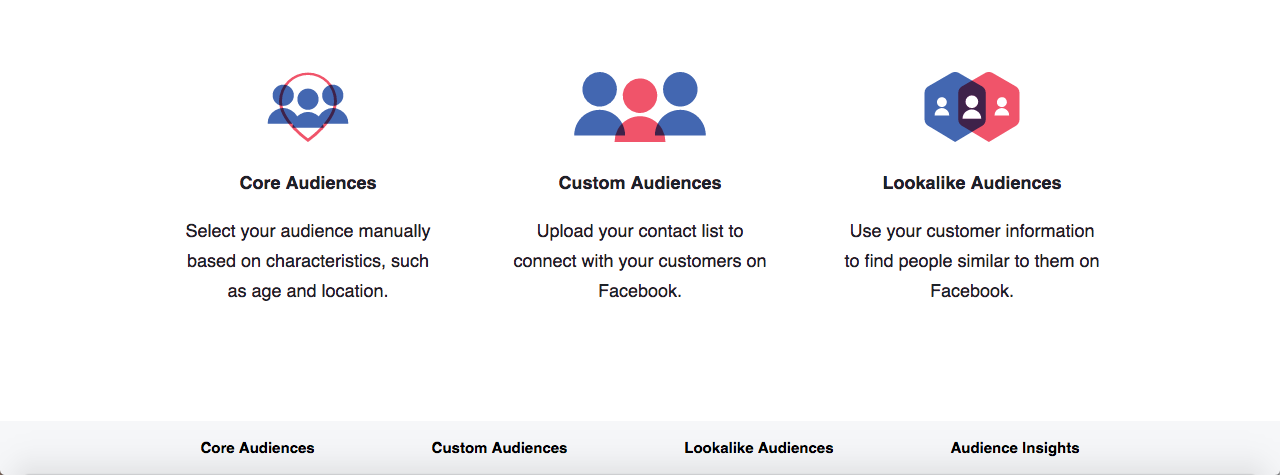
After you have identified your objective, the next step is to identify your target audience. Facebook makes it easy and steps you through the process. This is where you will spend most of your time defining whom it is you want to reach with your ads.
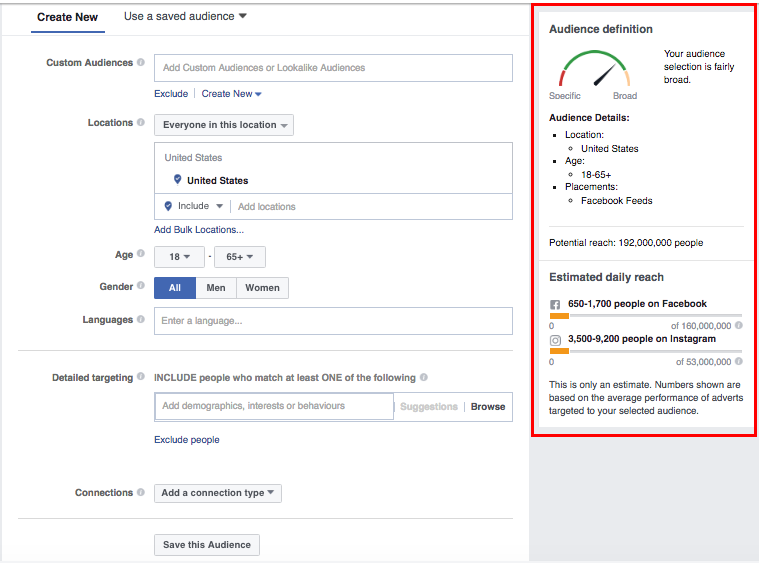
You choose your audience based on demographics, their behaviours, interests, and/or their contact information. There is a handy-dandy Audience definition (graph) to the right-hand side of the audience page (see the image below for an example). Use it to gauge how well you’ve defined your target audience. It will tell you the difference between how many people you are actually reaching versus how many people you could be reaching. To reach more of your targeted audience, increase your bids and budget.
You can also choose where your adverts will be placed or you can let Facebook automatically select this for you. We recommend that you select “Automatic Placements” when you first start out. The available placements are:
Facebook feeds (mobile and desktop)
Facebook right-hand column
Instagram
Audience Network
Know Your Ad Budget
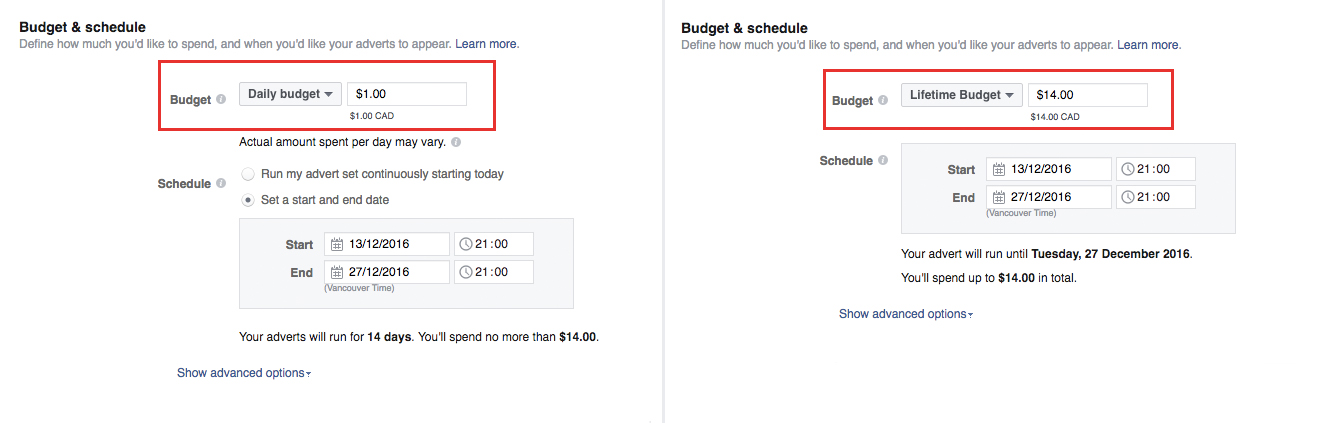
It’s important to know your budget before you start creating your advert campaign. Facebook has an ad for every budget making it affordable for everyone. It’s also important to know that there are two different types of budgets: Daily Budgets and Lifetime Budgets.
A Daily Budget is what you’re willing to pay for an ad per day. What you spend on the first and last days are prorated depending on the run time for those days. Meaning what time did the ad start on day one and what time did it end on the last day. Those two times may be different which is why the cost is prorated. The default minimum cost per day is still $1.00 for Daily Budgets. However, that doesn’t mean you’ll be charged $1.00 every day your campaign runs. For example, one day it might be $1.50 and another day $0.50 to maintain an average daily budget of $1.00. You can increase your daily budget to improve your ad’s exposure and reach. Remember, Facebook will always let you know the maximum amount you’ll spend during your campaign, so you don’t have to worry about going over budget.
A Lifetime Budget is what you’re willing to pay over the duration (lifetime) of an ad. Facebook tries to apply your budget evenly over the length of time the ad runs. The default minimum cost for Lifetime Budgets is $30.00, and like the Daily Budget, you can increase it to any amount you want which will improve your ad’s exposure and reach. Whether your ad runs for a week or a month, the cost will be at what you set it.
If you are just starting out, using the default Daily Budget option of $1.00 or even increasing it to $5.00 is more than enough to test the waters and see what works and what doesn’t. You can always change your budget once you’ve figured out which ad campaigns have worked the best for you.
Schedule Your Ad
Don’t forget to choose a schedule. There are two options:
Run my advert set continuously starting today.
Set a start and end date.
It’s up to you which option you choose, but if you’re someone who is a tad forgetful, then choose a specific time range. You can always stop the ad whenever you want. Remember the length of time your ad runs, also affects your budget. The longer it runs, the higher the cost. We recommend that you run an ad for no more than 3 weeks as Facebook ads tend to get stale by that point. You can always replace it with a new ad campaign with fresh images and text.
If you’re wondering how Facebook determines the cost of their ads, well it’s a bit complex and it doesn’t help that Facebook is constantly adjusting their formula. The exact cost associated with your advert being shown to someone is determined in Facebook’s Advert Auction. To learn more about it, read “Understanding how bidding and our ads auction work.”
Choose a Facebook Advert Format
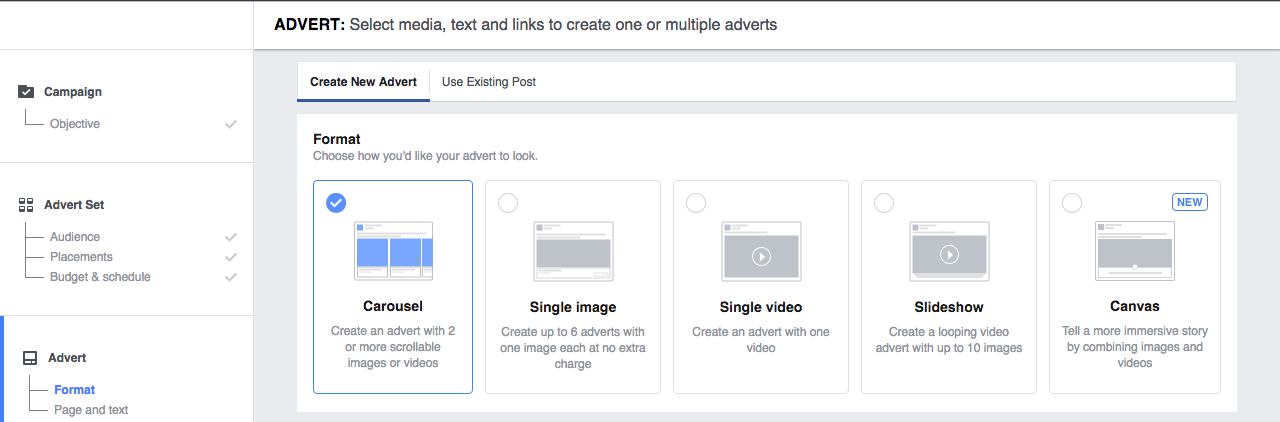
Facebook adverts offer more format options than ever before. There are five to choose from: Carousel, single image, single video, slideshow, or Canvas. While most of these formats are self-explanatory, Carousel and Canvas are not.
Carousel lets you show up to 10 images and/or videos in a single ad. When people view your ad, they can scroll through the carousel cards. One of the benefits of Carousel is that it lets businesses tell a story through carousel cards or to showcase one long image that is divided between the carousel cards.
Canvas is Facebook’s newest format and it allows you to combine both images and video. You can tell a more in-depth story about your products and/or services. It is customizable and there is no one way to create a Canvas ad. If you choose to design a Canvas ad, it’s best to plan in advance what type of experience you want to create for the viewer and to have all your media materials ready in advance.
Your ad will appear on desktop, mobile news feed, feature phone, and Instagram, so it’s important to follow Facebook’s guidelines when designing your ad. You want to ensure it looks good everywhere it appears whether it’s on Facebook, Instagram or your mobile phone. Listed below are the recommended design guidelines to ensure your ad displays the way you want it to:
Recommended image size: 1,200 x 628 pixels
Image ratio: 1.9:1
Text: 90 characters
Headline: 25 characters
Link description: 30 characters
Your images should have minimal amounts of text. Facebook adverts that contain images with little to no text tend to cost less and have better delivery than adverts with image text. So, what count’s as text in your advert image? Logos, watermarks, and numbers.
For a comprehensive list of design guidelines for each marketing objective, read Facebook’s “Adverts Guide.”
It’s easy to use your own images. Just remember to size them properly beforehand otherwise, they won’t upload or they will be cropped. Don’t have any of your own photos? You can use the free stock images provided by Shutterstock via Facebook.
There are three areas on your advert to add text: Text, Headline, and Link Description. You don’t have to use all of them. What text you include is up to you, but it’s always a good idea to have a call to action. You can even use Facebook’s “Call to Action” button which offers a number of options such as contact us, learn more, download, signup, and etc.
You now have the option to add a Facebook Pixel to your ad campaigns. The Facebook Pixel is a piece of code that you install on your website. It allows you to more effectively measure the performance of your ad campaigns and it helps you determine exactly who sees your ads. Learn more about it in our blog post, “How do Facebook Pixels Work – Getting Set Up.”
While designing your ad, there is an advert preview pane to the right that updates every time you make a change. There is also a drop down menu that shows you what your ad looks like on other platforms or you can use the arrow buttons to scroll through. You can experiment with your ad’s format, images, videos and text until you are satisfied with the results. You can make your advert as fancy or simple as you like.
Tracking The Results of Your Facebook Ads
Okay, so you’ve created your ad, hit the “Place Your Order” button and it has been reviewed and accepted by Facebook. What’s next? Track and measure the performance of your advert campaign using Facebook’s adverts analytics tools. Information is presented in easy and simple visual reports. Your report includes topics such as reach, actions taken, details on the audience that you reached and more. Reports are also tailored based on which marketing objective you chose. Use these analytic tools to determine if your campaign was a success and met your objectives and goals. The data can also inform your future campaigns.
Are you ready to get started? Need help? Just let us know. Facebook ad creation and management is just one of the many services we provide.
About the writer: Gloria Botelho is a practicum student from the Digital & Mobile Marketing program at Simon Fraser University. Gloria lives in East Van and is obsessed with cats, flowers, street art and all things Portuguese.
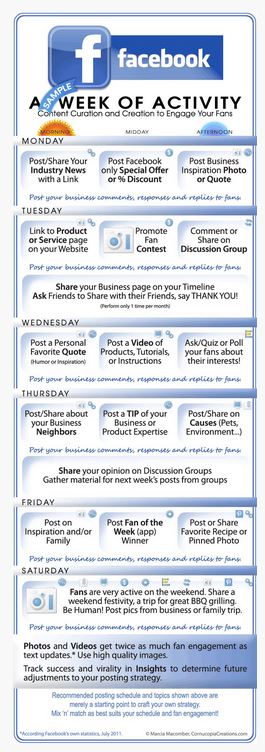
For those of us who manage Facebook pages, coming up with fresh ideas for content that will engage your audience can be a challenge. Rather than posting content adhoc, it is a really good practice to get into the habit of creating a content schedule for Facebook. Similar to an editorial schedule for a magazine, a Facebook content schedule outlines what you will post about at specific times throughout the week.
The infographic below from contains a great example of content creation strategies that will help you stay on track and engage your audience.
Note that how often post updates to your Facebook page will vary by audience. If your target audience is younger ( under 35) then posting several times a day is expected but if your target audience is older then once a day might suffice and more often will be a put off. Finding your own secret sauce will depend on trial and error.
When you are posting content to your Facebook business page, remember that text such as inspirational quotes, anecdotes and updates, is likely to garner more interactions than posting links and that photos and videos get even better response rates.
Having a schedule like this can really help you stay on track and will improve your productivity in this social network.
As the Facebook population grows, more and more businesses are using Facebook Pages to promote their business in this forum and to reach out and connect with fans there.Your Facebook page may be the first contact a prospect has with you and it is important to stand out from the crowd. One way to do this is by customizing your Facebook page to include tabs that go beyond the basic “Wall” and “Info” tabs in the vanilla page set up. Once you have created these new tabs you can customize each page. Here’s how:
Customize Your Facebook Page
First thing you need to do is add the Facebook Mark Up Language to your Page. To do this, Facebook search “FBML” find the FMBL application and click to add it to your site.
Once you have added this, go to your Page and click edit. Under “Applications” you will see FBML. Click to edit to add a new tab.
The box title shows “FBML”, edit this to show the title you want to appear on the tab on your page. Click to save. The new tab will now appear on your Facebook page.
To edit and add content to the page click to edit your page again and click to edit on the pertinent FBML application you just created. Finally, add the code you want to appear on the page.
The easiest way to generate the code is to use a CMS editor. I used WordPress to generate the code for the connect tab content I created on the Out-Smarts Page.
To add images to your new tab page, upload them to WordPress and use the hyperlink functionality if you want to link the image to an external page (exactly like you would if you were uploading and linking an image to a blog post).
Once you are happy with the content, copy and paste the HTML code into your FBML window. To find this click on applications then edit as before.
Click to complete and save. Go back to your Facebook page and voila, you will have a new tab there and if you click on the tab the content you created in WordPress will appear there.








 info@out-smarts.com
 604 909 3532